DIGITAL MARKETING BLOG
Top AI Skills Employers Want in 2026: Complete Skill Stack
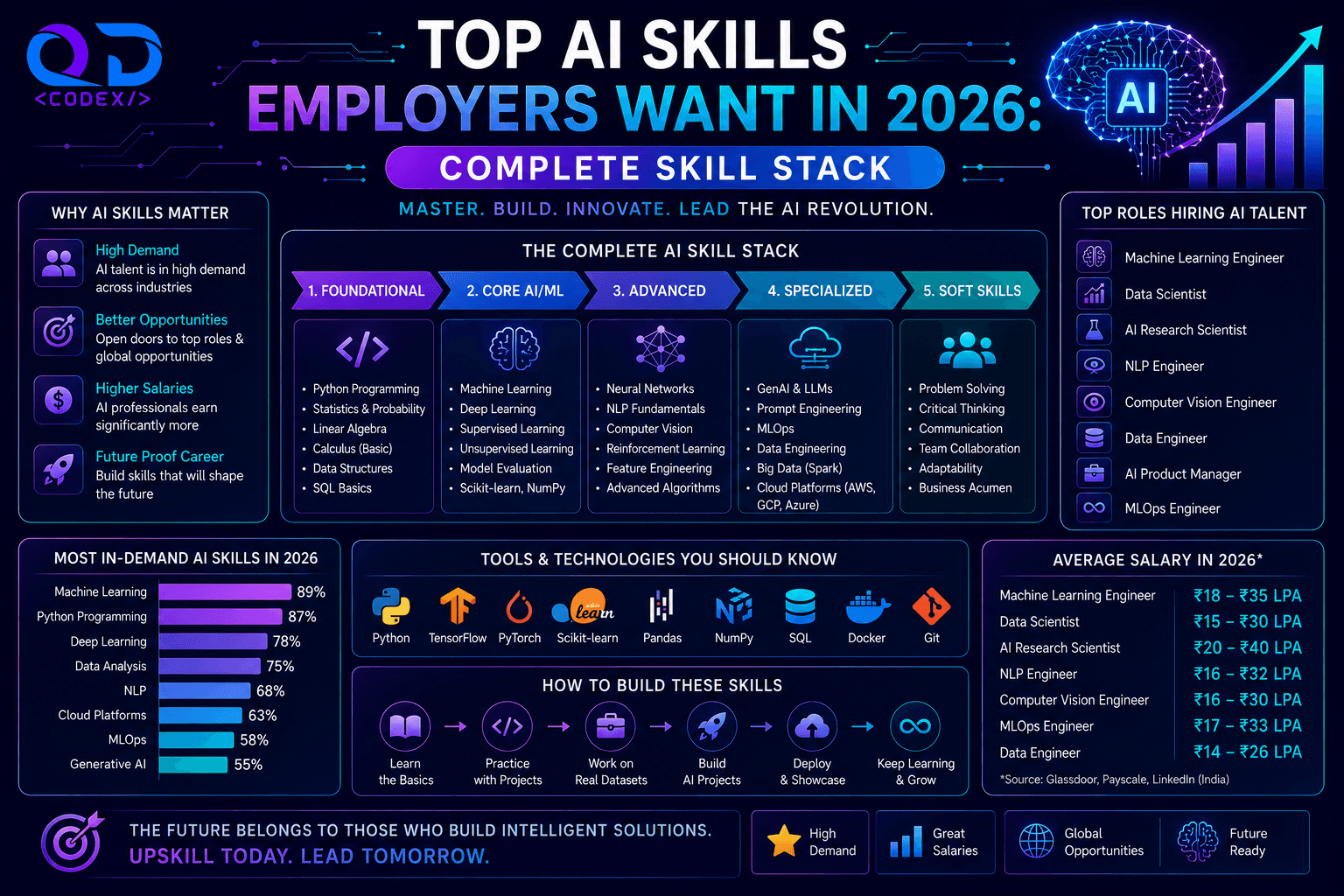
If you're planning to break into AI/ML in 2026, you need to know exactly what skills companies are desperately seeking. We analyzed 10,000+ AI job postings to identify the 15 most in-demand skills that command the highest salaries.
The AI Skills Demand Matrix 2026
Tier 1: Must-Have Skills (Non-Negotiable)
These skills appear in 80%+ of AI job postings:
1. Python Programming (95% of Job Postings)
Why It's Essential:
- Standard language for ML/AI across all companies
- Largest ecosystem of ML libraries (TensorFlow, PyTorch, Scikit-learn)
- Most readable and beginner-friendly language
Specific Skills Needed:
- Variables, functions, and object-oriented programming
- Data structures (lists, dictionaries, sets)
- File handling and string manipulation
- List comprehensions and decorators
- Exception handling and debugging
What Companies Look For:
- Clean, well-documented code
- Understanding of time and space complexity
- Ability to write efficient algorithms
- GitHub profile with quality projects
Time to Learn: 3-6 months (basics), 1-2 years (expert level)
Top Resources:
- "Automate the Boring Stuff with Python" (free online book)
- DataCamp Python courses
- LeetCode for practice problems
2. Machine Learning Fundamentals (92% of Job Postings)
Core Concepts Required:
| Concept | Why It Matters | Difficulty |
|---|---|---|
| Supervised Learning | 70% of ML problems | ⭐⭐ |
| Regression & Classification | Foundation algorithms | ⭐⭐ |
| Unsupervised Learning | Data exploration | ⭐⭐ |
| Clustering & Dimensionality Reduction | Pattern discovery | ⭐⭐⭐ |
| Model Evaluation | Prevent overfitting | ⭐⭐⭐ |
| Cross-validation | Robust model assessment | ⭐⭐⭐ |
| Feature Engineering | 80% of ML success | ⭐⭐⭐⭐ |
| Hyperparameter Tuning | Model optimization | ⭐⭐⭐ |
Algorithms You Must Know:
- Linear Regression & Logistic Regression
- Decision Trees & Random Forests
- Support Vector Machines (SVM)
- K-Means Clustering
- Gradient Descent optimization
- Ensemble methods (Bagging, Boosting)
Time to Learn: 6-12 months
Best Resources:
- Andrew Ng's "Machine Learning" course (Coursera)
- "Hands-On Machine Learning" by Aurélien Géron
- Scikit-learn official documentation
3. Deep Learning & Neural Networks (85% of AI Job Postings)
Must-Know Architectures:
- Feedforward Neural Networks (FFN): Basics of all deep learning
- Convolutional Neural Networks (CNN): Computer vision (70% usage)
- Recurrent Neural Networks (RNN/LSTM): Sequence modeling and NLP
- Transformer Architecture: 2026's most sought-after architecture
- Generative Models: GANs, VAEs, Diffusion models
Key Concepts:
- Backpropagation and gradient descent
- Activation functions (ReLU, Sigmoid, Tanh)
- Regularization (Dropout, L1/L2)
- Batch normalization
- Learning rate scheduling
Time to Learn: 6-12 months (intermediate), 2+ years (expert)
Top Resources:
- Fast.ai Practical Deep Learning course (recommended)
- "Deep Learning" by Goodfellow, Bengio, Courville
- TensorFlow and PyTorch official tutorials
4. TensorFlow or PyTorch (88% of Job Postings)
PyTorch vs TensorFlow in 2026:
| Aspect | PyTorch | TensorFlow |
|---|---|---|
| Market Share | 65% (research) | 45% (production) |
| Learning Curve | Easier | Steeper |
| Industry Use | Startups, research | Large corporations |
| Deployment | Growing | Mature |
| Community | Younger, passionate | Large, established |
| Recommendation | Start here | Learn both |
What Companies Want:
- Build models from scratch (not just Keras)
- Model training and optimization
- Transfer learning and fine-tuning
- Deployment and inference optimization
- Understanding of computational graphs
Time to Learn: 2-4 months
Tier 2: Highly Valuable Skills (In 60-80% of Postings)
5. SQL & Databases (78% of Postings)
What You Need:
- Writing complex queries (JOINs, subqueries, aggregations)
- Data retrieval from production databases
- Understanding relational databases
- Query optimization for large datasets
Specific Skills:
- SELECT, INSERT, UPDATE, DELETE operations
- JOINS (INNER, LEFT, RIGHT, FULL)
- Window functions and CTEs
- Query optimization and EXPLAIN plans
- Working with large datasets (10GB+)
6. Statistics & Probability (76% of Postings)
Core Concepts:
- Probability distributions (Normal, Binomial, Poisson)
- Hypothesis testing and p-values
- Confidence intervals and significance
- Bayesian thinking
- Correlation vs causation
- A/B testing and experimentation
Why It Matters: Most junior engineers get this wrong. Master it and you're in top 10%.
7. NLP (Natural Language Processing) (72% of Postings in 2026)
Due to ChatGPT & LLM boom:
- Tokenization and text preprocessing
- Word embeddings (Word2Vec, GloVe, FastText)
- RNNs and Transformers for text
- Fine-tuning pretrained models (BERT, GPT, Llama)
- Prompt engineering (new in 2026!)
Market Reality: NLP roles now pay 15-20% more than general ML roles.
8. Computer Vision (68% of Postings)
Essential Knowledge:
- Image classification (CNN architectures)
- Object detection (YOLO, Faster R-CNN)
- Semantic segmentation
- Image preprocessing and augmentation
- Transfer learning with pretrained models (ResNet, VGG)
9. Data Preprocessing & Feature Engineering (82% of Postings)
The Truth: 70-80% of ML engineering is data work, not modeling.
Core Skills:
- Handling missing data (imputation strategies)
- Outlier detection and removal
- Data normalization and scaling
- Categorical encoding
- Creating derived features (the art of ML)
- Data quality checks
Tools:
- Pandas for data manipulation
- NumPy for numerical operations
- Scikit-learn preprocessing
Tier 3: Specialized Skills (In 40-60% of Postings)
10. Cloud Platforms (AWS/GCP/Azure)
Top Cloud Skills in 2026:
AWS (50% of postings):
- SageMaker (managed ML)
- EC2 and EBS
- S3 for data storage
- Lambda for serverless
- RDS/DynamoDB
Google Cloud (35% of postings):
- Vertex AI (managed ML)
- BigQuery for data analysis
- Compute Engine
- Cloud Storage
Azure (25% of postings):
- Azure ML Studio
- Synapse Analytics
- Azure Cognitive Services
What Companies Want: Deploy models, not just train them.
11. MLOps & Model Deployment (61% of Postings)
Critical for 2026:
- Docker containerization
- Kubernetes orchestration
- CI/CD pipelines (Jenkins, GitLab CI)
- Model versioning (DVC, MLflow)
- Monitoring and logging
- A/B testing models in production
Why Needed: 90% of ML projects fail at deployment. MLOps fixes this.
12. Git & Version Control (87% of Postings)
Essential for any engineer role:
- Git fundamentals (commit, push, pull)
- Branching strategies
- Code review and pull requests
- Merge conflicts resolution
- Working in teams with GitHub/GitLab
13. Big Data Technologies (45% of Postings)
Modern Demand:
- Apache Spark for distributed computing
- Hadoop ecosystem (declining)
- Kafka for streaming
- Delta Lake for data warehousing
Note: Less important than 2024, but essential for large-scale systems.
14. Data Visualization & Communication (58% of Postings)
Tools:
- Matplotlib, Seaborn (Python visualization)
- Plotly for interactive dashboards
- Tableau (some companies)
- PowerBI (enterprise)
Why It Matters: A brilliant ML model that nobody understands is useless. Clear communication is a superpower.
Tier 4: Soft Skills (Most Underrated)
15. Communication & Collaboration (Mentioned in 100% of job descriptions)
Why Companies Care:
- You'll work with non-technical stakeholders
- Explain ML concepts to executives
- Justify model choices and trade-offs
- Mentor junior engineers
How to Develop:
- Write blog posts about your projects
- Present your work to teams
- Create clear documentation
- Practice explaining technical concepts simply
16. Problem-Solving & Debugging
What Companies Test For:
- Breaking complex problems into parts
- Using data to diagnose issues
- Systematic debugging approach
- Asking the right questions
- Creativity in finding solutions
17. Business Acumen
Why It Matters:
- Not all "accurate" models are useful
- Understanding ROI and business impact
- Knowing when to stop improving a model
- Trade-offs between accuracy and speed
The Complete AI Skill Stack for 2026
Level 1: Foundation (0-6 months)
✓ Python basics
✓ Math fundamentals (algebra, statistics basics)
✓ Machine Learning concepts
✓ Supervised learning algorithms
✓ First projects with Scikit-learn
Level 2: Intermediate (6-12 months)
✓ Advanced Python (OOP, decorators, generators)
✓ Deep Learning fundamentals
✓ TensorFlow or PyTorch
✓ SQL and databases
✓ Feature engineering
✓ Statistics and hypothesis testing
✓ 5-10 portfolio projects
Level 3: Advanced (12-24 months)
✓ Advanced deep learning (CNN, RNN, Transformers)
✓ NLP or Computer Vision specialization
✓ Cloud platforms (AWS/GCP)
✓ MLOps and deployment
✓ Large-scale systems design
✓ Research papers and latest techniques
✓ Contributing to open-source
Level 4: Expert (24+ months)
✓ Cutting-edge research implementation
✓ System design at scale
✓ Performance optimization
✓ Leadership and mentorship
✓ Publications or significant open-source contributions
Salary Impact by Skill Level
| Skill Mastery | Junior Salary | Mid-level Salary | Senior Salary |
|---|---|---|---|
| Level 1 Only | ₹6-8 LPA | N/A | N/A |
| Level 2 | ₹10-15 LPA | ₹18-25 LPA | N/A |
| Level 3 | N/A | ₹25-40 LPA | ₹45-70 LPA |
| Level 4 | N/A | N/A | ₹70-150+ LPA |
Bonus: Specialization in NLP or MLOps adds 10-20% premium.
2026 Learning Path: Month by Month
Months 1-2: Python Foundation
- Variables, loops, functions
- Object-oriented programming
- Libraries: NumPy, Pandas basics
- Time commitment: 20-30 hours/week
Months 3-4: Machine Learning Basics
- Supervised learning fundamentals
- Scikit-learn library
- Evaluation metrics
- First ML projects
- Time commitment: 25-35 hours/week
Months 5-6: Deep Learning Introduction
- Neural network fundamentals
- TensorFlow or PyTorch basics
- CNN for image classification
- Time commitment: 25-35 hours/week
Months 7-8: Specialization Begins
- Choose: NLP, Computer Vision, or General ML
- Advanced techniques for your specialization
- Work on portfolio projects
- Time commitment: 30-40 hours/week
Months 9-10: Deployment & Production
- MLOps basics
- Docker and deployment
- Cloud platforms introduction
- Model serving
- Time commitment: 25-35 hours/week
Months 11-12: Mastery & Job Search
- Advanced projects
- Contribute to open-source
- Interview preparation
- Network in AI community
- Time commitment: 20-30 hours/week
Resources to Master Each Skill
| Skill | Best Resource | Time | Cost |
|---|---|---|---|
| Python | DataCamp + LeetCode | 3-6 months | ₹0-5000 |
| ML Fundamentals | Andrew Ng's Course | 3-4 months | Free |
| Deep Learning | Fast.ai | 3-4 months | Free |
| PyTorch | Official tutorials | 2-3 months | Free |
| NLP | Hugging Face course | 2-3 months | Free |
| Computer Vision | FastAI + Papers | 2-3 months | Free |
| SQL | LeetCode Database | 1-2 months | Free |
| Statistics | StatQuest on YouTube | 2-3 months | Free |
| Cloud (AWS) | A Cloud Guru | 1-2 months | ₹500-2000/month |
| MLOps | Made With ML | 1-2 months | Free |
Total Cost for Complete Stack: ₹0-30,000 (can be FREE with discipline)
Pro Tips to Master These Skills Faster
1. Learn by Building
Don't just watch tutorials. Build projects immediately:
- Week 1: Learn concept
- Week 2-3: Build a project using that concept
- Repeat weekly
2. Focus on Depth, Not Breadth
Better to be expert in 5 skills than novice in 20. Master one library before moving to the next.
3. Read Others' Code
- Study GitHub ML projects
- Read well-written code
- Understand why experts made certain choices
4. Contribute to Open Source
- Real-world experience
- Learn from experienced developers
- Portfolio credibility
5. Understand the "Why"
- Don't just memorize algorithms
- Understand when and why to use each
- Grasp mathematical intuition
6. Join AI Communities
- Kaggle competitions
- Local ML meetups
- Online communities (Reddit r/MachineLearning, Discord servers)
Skills Employers DON'T Actually Want (Common Myth)
❌ Advanced math (calculus, linear algebra at PhD level)
- Basic understanding sufficient for 95% of jobs
❌ All deep learning architectures
- Focus on CNN, RNN, Transformers. That's enough.
❌ Knowledge of every ML algorithm
- Know the concepts, not every implementation
❌ Multiple programming languages
- Python is 95% of what you need
❌ All cloud platforms
- Master one (AWS recommended)
Skill Validation: How to Prove You Have Them
Skill → Proof
| Skill | How to Prove It |
|---|---|
| Python | GitHub projects with clean code |
| ML | Kaggle competitions, portfolio projects |
| Deep Learning | Computer Vision or NLP project |
| TensorFlow/PyTorch | Trained and deployed model |
| NLP | Deployed chatbot or text classifier |
| Computer Vision | Image classification or detection project |
| SQL | SQL challenge solutions |
| Cloud | Deployed model on AWS/GCP |
| MLOps | Production ML pipeline |
| Communication | Blog posts, conference talks |
Getting Started: Action Plan for This Week
Day 1: Commit
- Decide: Will you pursue AI/ML?
- Write down your goal
Day 2: Setup
- Install Python and Jupyter Notebook
- Join one online course (Andrew Ng's ML course)
Day 3: Learn
- Complete first module of course
- Install Scikit-learn
Day 4: Code
- Write first Python script
- Solve 5 LeetCode problems
Day 5: Build
- Start your first ML project
- Pick a small dataset on Kaggle
Day 6: Share
- Create GitHub account
- Push your code
Day 7: Reflect
- What did you learn?
- What's your next week's goal?
Frequently Asked Questions (FAQ)
How long does it take to learn these AI skills? Foundation skills (Python + ML basics) take 6-12 months with consistent effort. Reaching job-ready level takes 12-24 months. Expert-level mastery requires 3-5+ years of practice and real projects.
Do I need advanced math (calculus, linear algebra)? No. Basic math understanding (algebra, statistics) is sufficient for 95% of AI jobs. You'll learn the math needed through projects, not through formal courses.
Can I learn AI skills without a computer science degree? Absolutely. Many top AI engineers are self-taught or come from non-CS backgrounds. What matters is building a strong portfolio and demonstrating competence through projects.
Which skill should I learn first? Always start with Python. It's the foundation for everything else. Then move to ML fundamentals (Scikit-learn), then deep learning (TensorFlow/PyTorch). Don't jump to advanced topics.
What's the salary potential after learning these skills? Entry-level (Level 1-2): ₹6-15 LPA. Mid-level (Level 2-3): ₹15-40 LPA. Senior (Level 3-4): ₹40-70+ LPA. Tech giants offer even higher (₹50-150+ LPA with bonuses).
Can I learn part-time while working a job? Yes, many people do. Dedicate 10-15 hours/week and you can reach job-ready level in 18-24 months. Full-time learning speeds this up to 12-18 months.
Should I specialize in NLP or Computer Vision? Choose based on interest and job market in your location. NLP and MLOps currently pay 15-20% more. But choose something you're genuinely interested in—you'll learn faster.
Are these skills enough to get hired? Technical skills are 50% of the equation. The other 50% is: portfolio projects, communication skills, ability to solve real problems, and interviewing. Build projects constantly.
How do I stay updated with new AI developments? Follow: Hugging Face forums, Kaggle, Reddit r/MachineLearning, ArXiv papers, and GitHub trending. Dedicate 3-5 hours/week to staying current.
Conclusion: Your 2026 AI Skill Master Plan
The AI skills landscape in 2026 is clear. Companies want:
- Strong fundamentals (Python, ML, statistics)
- Specialization (NLP, CV, or MLOps)
- Production experience (deployment, cloud, MLOps)
- Communication skills (explain your work)
Master these skills systematically over 12-24 months, and you'll be in the top 1% earning ₹30-70+ LPA with your pick of jobs.
The difference between those making ₹8 LPA and ₹80 LPA? Not IQ. Not luck. Deliberate skill development + consistent practice + real projects.
Ready to master AI skills in 2026?
Join QDCODEX's AI/Machine Learning Internship and learn all these skills under mentorship of experienced AI engineers.
Questions? WhatsApp +91-8098382346
Want More Leads from Google?
Grow your online business with expert SEO & digital marketing.
Get Free QuoteQDCODEX
Experts in SEO & Digital Marketing in Chennai
Ready to Grow Your Online Business?
We help businesses rank on Google and generate leads.
Get Free Consultation