DIGITAL MARKETING BLOG
Future of AI: Top Career Paths in Artificial Intelligence 2026-2030
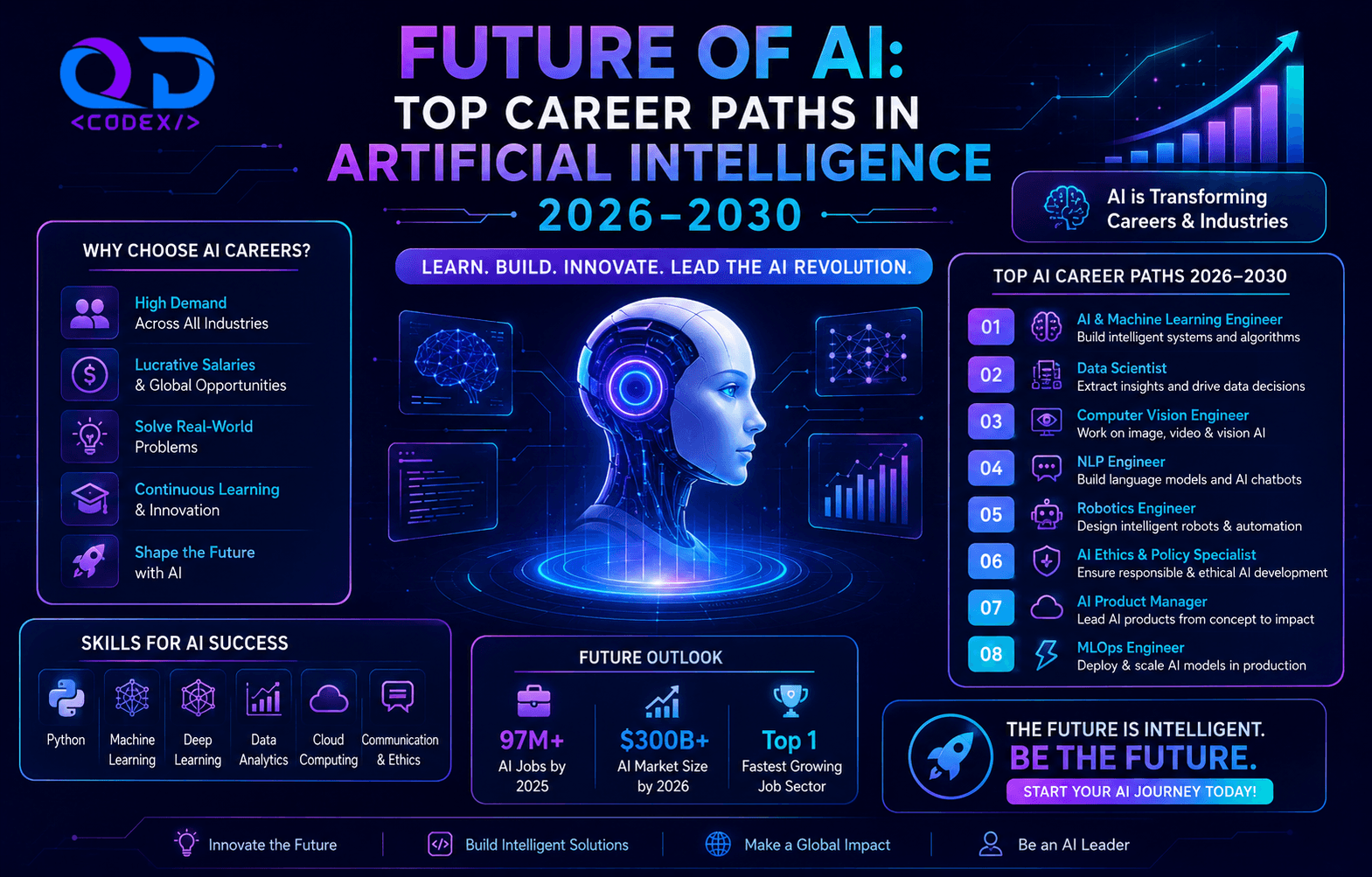
The future of work is fundamentally changing. Artificial Intelligence is not just a technology trend—it's reshaping every industry, creating entirely new job categories while transforming existing roles. If you're considering a career in AI, understanding where the industry is heading is crucial.
The AI Job Market in 2026
Growth Projections
- AI-related jobs: Growing at 74% annually (vs 5% for general jobs)
- Job postings: 3.5x more AI roles than available talent
- Salary premium: AI professionals earn 20-40% more than peers
- Industries hiring: Tech, finance, healthcare, retail, manufacturing, education
Why the Shortage?
- Rapid industry expansion exceeds talent supply
- High barrier to entry (requires specialized skills)
- Many professionals lack current AI/ML certifications
- Generational gap—not many AI experts from earlier decades
Top AI Career Paths in 2026
1. Machine Learning Engineer (Highest Demand)
Role: Design, build, and deploy ML models at scale
Responsibilities:
- Develop algorithms for specific business problems
- Optimize model performance and latency
- Deploy models to production environments
- Monitor and retrain models with new data
- Collaborate with data scientists and engineers
Salary Range:
- Junior (0-2 yrs): ₹8-12 LPA
- Mid-level (2-5 yrs): ₹15-25 LPA
- Senior (5+ yrs): ₹30-50+ LPA
- Tech giants: ₹50-100+ LPA + bonuses + stock options
Skills Required:
- Python, Java, or Scala
- TensorFlow, PyTorch, Scikit-learn
- SQL and distributed systems (Spark)
- Production ML (MLOps)
- Statistics and linear algebra
Future Outlook: Explosive growth, most stable role in AI
2. AI/ML Researcher
Role: Push the boundaries of what's possible with AI
Responsibilities:
- Develop novel algorithms and architectures
- Publish research papers in top venues
- Implement cutting-edge models
- Mentor junior researchers
- Secure research funding and grants
Salary Range:
- PhD fresh grad: ₹12-15 LPA (India), $120K-150K (US)
- Postdoc/Senior Researcher: ₹20-30 LPA, $150K-250K (US)
- Research Lead: ₹40+ LPA, $250K-400K+ (US)
Skills Required:
- PhD in ML, CS, or related field (preferred)
- Deep mathematical understanding
- Proficiency in writing papers
- TensorFlow/PyTorch expertise
- GPU computing and distributed systems
Future Outlook: Elite roles, limited positions, highest prestige
3. NLP (Natural Language Processing) Specialist
Role: Build systems that understand and generate human language
Responsibilities:
- Develop language models and translation systems
- Build chatbots and conversational AI
- Work on text classification and sentiment analysis
- Fine-tune large language models (LLMs)
- Deploy NLP solutions in production
Salary Range:
- Junior: ₹10-15 LPA
- Mid-level: ₹20-35 LPA
- Senior NLP Engineer: ₹40-60+ LPA
- Tech leaders (OpenAI, Google Brain): ₹75-150+ LPA
Skills Required:
- Large Language Models (GPT, BERT, Llama)
- Transformer architectures
- PyTorch or TensorFlow
- Linguistics concepts (optional but valuable)
- Fine-tuning and prompt engineering
Future Outlook: Hottest field in 2026, competition increasing
4. Computer Vision Engineer
Role: Build systems that see and interpret images/video
Responsibilities:
- Develop image recognition and classification models
- Build object detection systems
- Work on autonomous vehicles and robotics
- Create video analysis solutions
- Optimize models for mobile and edge devices
Salary Range:
- Junior: ₹10-14 LPA
- Mid-level: ₹18-32 LPA
- Senior: ₹35-55+ LPA
- Autonomous Vehicle Companies: ₹60-100+ LPA
Skills Required:
- CNN architectures (ResNet, YOLO, Mask R-CNN)
- OpenCV and image processing
- PyTorch/TensorFlow
- Edge computing (TensorFlow Lite, ONNX)
- 3D geometry and computer graphics
Future Outlook: Steady demand, critical for robotics and autonomous systems
5. Data Scientist (Transitioning Role)
Role: Extract insights from data to drive business decisions
Responsibilities:
- Exploratory data analysis and visualization
- Statistical modeling and hypothesis testing
- Build and evaluate ML models
- Create dashboards and reports
- Communicate findings to stakeholders
Salary Range:
- Junior Data Scientist: ₹6-10 LPA
- Mid-level: ₹12-20 LPA
- Senior Data Scientist: ₹25-40 LPA
- Data Science Managers: ₹40-60+ LPA
Skills Required:
- Python (Pandas, NumPy, Scikit-learn)
- SQL and databases
- Statistics and experimentation
- Data visualization (Tableau, PowerBI)
- Business acumen
Future Outlook: Market saturation, moving toward specialized roles (NLP, CV, MLOps)
6. MLOps/ML Infrastructure Engineer (Emerging)
Role: Build systems to deploy, monitor, and maintain ML models
Responsibilities:
- Design ML pipelines and CI/CD systems
- Model serving and API development
- Monitor model performance in production
- Version control for data and models
- Infrastructure optimization and scaling
Salary Range:
- Junior MLOps: ₹12-16 LPA
- Mid-level: ₹20-30 LPA
- Senior MLOps Architect: ₹35-60+ LPA
Skills Required:
- Docker and Kubernetes
- Cloud platforms (AWS, GCP, Azure)
- CI/CD tools (Jenkins, GitLab CI)
- Monitoring tools (Prometheus, ELK)
- SQL and distributed systems
Future Outlook: Fastest growing role, critical for scaling AI
7. AI Product Manager (Business Side)
Role: Guide AI product strategy and go-to-market
Responsibilities:
- Define AI product roadmap
- Work with technical and business teams
- Understand market and competition
- Communicate AI capabilities to customers
- Measure product impact and ROI
Salary Range:
- Associate PM: ₹12-18 LPA
- Senior PM: ₹30-50 LPA
- Principal PM (Google, Meta): ₹60-100+ LPA
Skills Required:
- Technical understanding of AI/ML
- Product strategy and business acumen
- Data analysis and metrics
- Communication and leadership
- Customer empathy
Future Outlook: High demand as companies need people who bridge tech and business
8. Robotics & Autonomous Systems Engineer
Role: Develop robots and autonomous systems powered by AI
Responsibilities:
- Design control systems for robots
- Develop computer vision for autonomous vehicles
- Implement real-time AI on edge devices
- Test and validate autonomous systems
- Collaborate with hardware engineers
Salary Range:
- Junior: ₹11-15 LPA (India), $100-130K (US)
- Mid-level: ₹22-35 LPA, $150-200K (US)
- Senior: ₹40-70+ LPA, $200-300K+ (US)
Skills Required:
- Deep learning and real-time systems
- ROS (Robot Operating System)
- Computer vision
- Control theory basics
- C++ and low-level optimization
Future Outlook: Explosive growth in autonomous vehicles and robotics
Emerging Specializations (2026-2030)
Generative AI Specialist
Focus on large language models, image generation (Stable Diffusion, DALL-E), and creative AI applications.
AI Ethics & Safety Researcher
Ensure AI systems are safe, fair, unbiased, and explainable.
Prompt Engineer
Optimize interactions with large language models—highest starting salaries!
AI Trainer/Annotator
Prepare and label datasets for training AI models. Good entry point for non-technical professionals.
Salary Comparison: AI vs Traditional Tech
| Role | AI (2026) | Traditional Tech | Difference |
|---|---|---|---|
| Junior Engineer (0-2 yrs) | ₹10-15 LPA | ₹6-9 LPA | +40-60% |
| Mid-level Engineer (2-5 yrs) | ₹22-35 LPA | ₹14-20 LPA | +50-75% |
| Senior Engineer (5+ yrs) | ₹45-70 LPA | ₹30-45 LPA | +40-55% |
| Tech Lead/Manager | ₹70-120 LPA | ₹50-80 LPA | +40-50% |
Bonus: AI professionals also receive higher stock options and bonuses (20-50% of base salary).
How to Position Yourself for Future AI Roles
2026 Strategy: Build Foundation
- Learn: Python, statistics, basic ML
- Build: 5-10 portfolio projects
- Intern: 2-3 month AI/ML internship
- Target Role: Junior ML Engineer or Data Scientist
2027-2028: Specialize
- Choose Path: NLP, CV, MLOps, or Research
- Deepen Skills: Advanced frameworks and domain expertise
- Lead Projects: Own end-to-end ML projects
- Target Role: Senior ML Engineer or Specialist
2029-2030: Leadership
- System Design: Design entire ML systems at scale
- Mentorship: Guide junior engineers
- Innovation: Contribute novel ideas or research
- Target Role: Staff Engineer, Research Lead, or AI Product Manager
Industry Outlook: 2026-2030 Predictions
Trends Shaping AI Careers
- Democratization of AI: Tools make AI accessible to non-experts
- Specialization: General "Data Scientist" role splits into specialized paths
- AI + Domain Expertise: Domain knowledge becomes more valuable
- Ethics & Regulation: Job security through responsible AI practices
- Real-time AI: Models serving predictions in milliseconds become standard
- Edge AI: Models running on phones and IoT devices expand opportunities
Roles Declining
- Traditional Data Scientist (too general)
- Manual data annotation (automated by AI)
- Business analyst (replaced by AI-powered tools)
Roles Exploding
- ML Engineer (production-focused)
- MLOps Engineer (infrastructure)
- NLP/Prompt Engineer (new field)
- AI Product Manager (bridge role)
Getting Started With AI Career in 2026
Option 1: University Path (Long-term)
- Timeline: 4 years (Bachelor's) + optional 2 years (Master's)
- Cost: ₹5-20 LPA (tuition varies)
- Advantage: Comprehensive education, research opportunities
- Drawback: Long duration before entering job market
Option 2: Bootcamp/Internship Path (Recommended)
- Timeline: 4-12 weeks intensive training + job placement support
- Cost: ₹5,000-₹2,00,000 (varies)
- Advantage: Fast entry to job market, industry mentors, real projects
- Drawback: Less theoretical depth (but sufficient for 90% of jobs)
Option 3: Self-Study + Portfolio
- Timeline: 6-12 months of consistent learning
- Cost: Free-₹50,000 (online courses)
- Advantage: Maximum flexibility, learning at own pace
- Drawback: Requires self-discipline, no mentorship
Recommended: Combination of bootcamp + self-study + real projects
Final Thoughts: Your AI Career Future
The AI revolution is here. In 2026, choosing an AI career is choosing one of the highest-paying, most secure, most impactful fields available. The next decade will see AI specialists become as essential as software engineers are today.
The best time to start was 5 years ago. The second best time is today.
Start your AI career journey now. By 2030, you could be leading AI teams, earning 2-3x more than your peers, and solving humanity's biggest challenges.
Frequently Asked Questions (FAQ)
Which AI career path pays the most in 2026? AI/ML Researchers and NLP Specialists earn the highest in academia/research. In industry, ML Engineers and MLOps Engineers earn ₹40-100+ LPA. Prompt Engineers in 2026 have the highest starting salaries despite being new.
Can I switch from software development to AI without a degree? Yes. Your software engineering background is actually an advantage. Focus on ML fundamentals for 6-9 months, build projects, and you can transition to AI engineering or MLOps.
What's the difference between a Data Scientist and ML Engineer? Data Scientists focus on analysis, insights, and experimentation. ML Engineers focus on building production-ready systems at scale. ML Engineers typically earn 20-30% more.
How much experience do I need to start as a junior ML engineer? Ideally 1-2 years of related experience or 5-10 solid portfolio projects. Some startups hire talented fresh graduates with impressive projects and no formal experience.
Is it too late to start an AI career in 2026? Not at all. AI talent shortage continues through at least 2030. With focused effort for 12-18 months, you can land your first AI role at competitive salary.
Do I need a PhD to work as an AI researcher? For industry research: No, a Master's is usually sufficient. For academic research: Yes, typically required. For specialized roles in Google Brain, Meta AI: Bachelor's + strong portfolio can work.
Should I focus on a specific specialization or stay general? Specialize. By 2027-2028, "general ML engineer" roles will decline further. Pick NLP, Computer Vision, MLOps, or Robotics and become deeply skilled in one area.
What's the best way to transition from Data Science to ML Engineering? Learn MLOps, Docker, Kubernetes, and cloud deployment. Build end-to-end ML projects, not just notebooks. Focus on production-quality code and system design.
Ready to launch your AI career? Join QDCODEX's AI/Machine Learning Internship program in Chennai and position yourself for 2026 and beyond.
Questions? Contact us at +91-8098382346 or visit our website
Want More Leads from Google?
Grow your online business with expert SEO & digital marketing.
Get Free QuoteQDCODEX
Experts in SEO & Digital Marketing in Chennai
Ready to Grow Your Online Business?
We help businesses rank on Google and generate leads.
Get Free Consultation