DIGITAL MARKETING BLOG
MLM Compensation Plans Explained: Types, Structures & Implementation
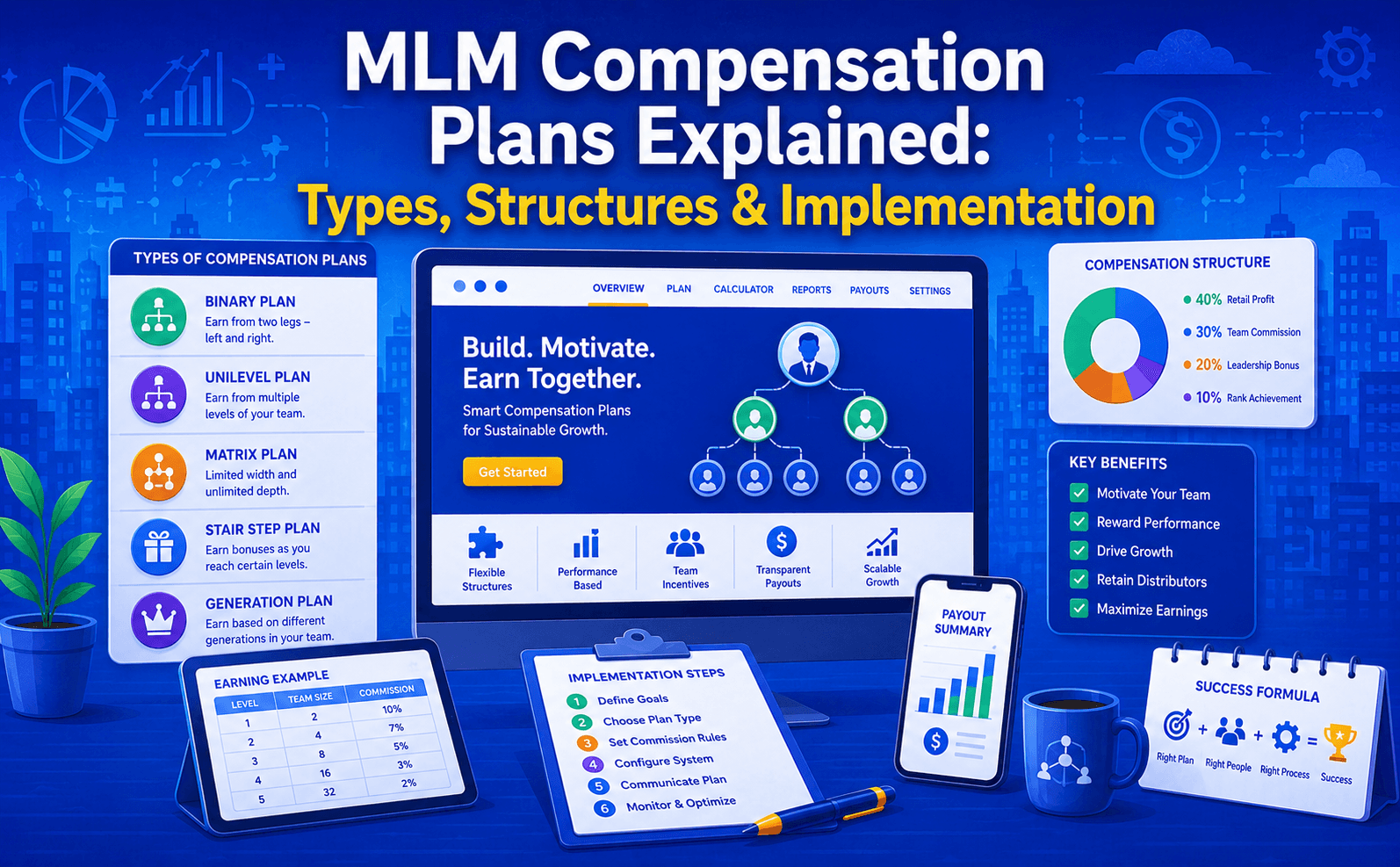
The compensation plan is the heart of any MLM business. It defines how members earn income and ultimately determines the success or failure of your network. Understanding different structures and how to implement them properly is crucial.
What is an MLM Compensation Plan?
An MLM compensation plan is a structured system that determines how earnings are distributed among members based on:
- Personal sales (retail sales made by the member)
- Group sales (sales made by their network)
- Recruitment (bringing new members into the network)
- Rank achievement (advancing to higher levels)
Major MLM Compensation Plan Types
1. Unilevel Plans
Structure: Each member can have unlimited direct recruits in their front line.
How it works:
        You
       / | \
      A  B  C  (Unlimited recruits)
     /|  |  |\
    D E  F  G H  (2nd Level)
Advantages:
- Simple to understand
- Members aren't limited in recruitment
- Easier to build deep organizations
- Good for retail-focused businesses
- Lower administrative complexity
Disadvantages:
- Can create unbalanced organizations
- Some members have larger downlines than others
- Harder for newer members to earn
- Potential for "heavy-hitters" dominating
Typical Commission Structure:
- Level 1: 10-20%
- Level 2: 5-10%
- Level 3: 2-5%
- Levels 4+: 0-2% (diminishing returns)
Best for: Retail-focused MLMs, insurance companies, affiliate programs
2. Binary Plans
Structure: Each member can only have two direct recruits (left leg and right leg).
How it works:
          You
         /  \
        A    B
       / \  / \
      C   D E   F
Advantages:
- Forces balanced growth
- Encourages teamwork (weaker leg gets help)
- All members have equal opportunity
- Creates strong teams
- Good for recruitment-focused businesses
Disadvantages:
- Limited direct recruits (only 2)
- Additional recruits must be placed elsewhere
- Spillover creates dependencies
- More complex to explain
- Can create frustration for recruiters
Typical Commission Structure:
- Binary matching bonus: 5-15% on weaker leg
- Rollup bonuses when binary pair completes
- Breakaway commissions at higher ranks
- Matching bonuses: 3-10% when team completes
Best for: Recruitment-heavy MLMs, network insurance, franchises
3. Matrix Plans
Structure: Fixed width (number of direct recruits) and fixed depth (number of levels).
Common examples: 2x7 (2 wide, 7 deep), 3x9, 5x7
2x7 Matrix Example:
Level 1:        You (2 recruits max)
Level 2:       A    B
Level 3:      C D  E F
Level 4:    G H I J K L M N
... (continuing down 7 levels)
Advantages:
- Very organized structure
- Predictable growth patterns
- Easy to calculate payouts
- Good balance between recruitment and retail
- Simpler compensation calculations
Disadvantages:
- Limited direct recruit slots (creates overflow)
- Spillover must go elsewhere
- Can frustrate aggressive recruiters
- Requires frequent spillover management
- Fixed structure may not suit all businesses
Typical Commission Structure:
- Level 1: 10-15%
- Level 2: 5-10%
- Levels 3-7: 2-5%
- Flush bonus: Payment when matrix completes
- Matching bonuses: 3-7%
Best for: Mixed retail/recruitment MLMs, insurance, education, wellness
4. Hybrid Plans
Structure: Combination of two or more compensation structures.
Examples:
Example 1: Unilevel + Matrix Hybrid
- First two levels unilevel (unlimited)
- Levels 3+ follow matrix structure
Example 2: Binary + Matching Bonus
- Binary structure for placement
- Additional matching bonuses on matched volume
- Tiered bonuses as you rank up
Advantages:
- Customizable to business model
- Can combine strengths of multiple plans
- More flexibility
- Better balanced earnings
Disadvantages:
- More complex to explain
- Harder to calculate
- Requires sophisticated software
- Potential for confusion
Best for: Larger MLMs, complex business models, multi-product companies
Advanced Compensation Components
1. Rank Bonuses
Members receive bonuses for achieving specific ranks:
- Rank 1: $100 monthly
- Rank 2: $250 monthly
- Rank 3: $500 monthly
- Rank 4: $1,000 monthly
Motivation: Encourages personal development and team building
2. Volume Bonuses
Bonuses paid when personal/group volume exceeds targets:
- Reach 1,000 PV: $50 bonus
- Reach 5,000 PV: $250 bonus
- Reach 10,000 PV: $500 bonus
3. Matching Bonuses
Pay members a percentage of their recruits' earnings:
- Match up to 50% of Level 1's earnings
- Match up to 25% of Level 2's earnings
4. Rollup/Carryover Bonuses
Unused commission volume "rolls up" to next month or carries over to higher earners
5. Fast-Start Bonuses
Special bonuses for new member recruitment:
- $50 per recruit in first month
- $100 for recruiting 3+ in first month
- $250 for 10+ recruits
6. Rank Advancement Bonuses
One-time payments for achieving new ranks:
- $500 for reaching Senior Member
- $1,000 for reaching Manager
- $5,000 for reaching Director
7. Car Bonuses / Vehicle Subsidies
- Free car for top earners
- Monthly car allowance ($300-$1,000)
- Conditional on maintaining rank
Implementation Best Practices
1. Keep It Simple (At First)
Start with basic structure:
- Single compensation type
- 3-5 income levels
- Clear percentage rates
- Easy calculation method
Then add complexity as needed.
2. Ensure Profitability
Calculate Total Payout Rate:
If you pay:
- Level 1: 15%
- Level 2: 10%
- Level 3: 5%
- Level 4: 2%

Total: 32% of revenue goes to commissions
Ensure: You retain at least 40% for operations/profit
3. Balance Recruitment vs. Retail
- If too recruitment-focused: Becomes pyramid scheme
- If too retail-focused: Members don't get excited about recruiting
- Target: 70-80% from retail sales, 20-30% from recruitment incentives
4. Implement Qualification Requirements
- Minimum personal sales to earn commission
- Minimum team volume to earn matching bonuses
- Activity requirements to maintain status
- Sales requirements for rank advancement
Example:
- Must sell $500 personal volume monthly to earn matching bonuses
- Must maintain $2,000 team volume to keep rank
- Must recruit 2+ people per quarter to receive recruitment bonuses
5. Create Clear Documentation
- Written compensation plan document
- Visual diagrams of structures
- Examples with real numbers
- Earnings scenarios for different levels
- FAQ addressing common questions
6. Software Integration
Your MLM platform should:
- Automatically calculate all compensation types
- Support plan modifications without coding
- Generate earnings statements
- Provide tax documentation
- Handle multiple plan variants
7. Regular Review & Optimization
- Monitor actual payouts vs. projections
- Identify payment anomalies
- Adjust rates if necessary
- Communicate changes clearly
- Maintain historical data
Common Mistakes to Avoid
❌ Mistake 1: Overly Complex Plans
Problem: Members don't understand how they earn money Solution: Start simple, add complexity gradually
❌ Mistake 2: Unsustainable Payout Ratios
Problem: Company can't afford payouts, becomes unprofitable Solution: Cap total compensation at 30-40% of revenue
❌ Mistake 3: Recruitment-Only Focus
Problem: Looks like pyramid scheme, violates FTC regulations Solution: Require 50%+ of revenue from retail sales
❌ Mistake 4: No Documentation
Problem: Members don't understand rules, disputes arise Solution: Create comprehensive written documentation
❌ Mistake 5: Inflexible Structure
Problem: Can't adapt to market changes Solution: Design modular systems that allow adjustments
Legal & Regulatory Considerations
FTC Requirements for Legitimate MLM:
✓ Focus on retail sales: Majority of revenue from end consumers ✓ Income disclosure: Transparent about realistic earnings ✓ No recruitment requirement: Can make money without recruiting ✓ No inventory loading: Members shouldn't accumulate unsold inventory ✓ Buyback policy: Company should buy back unsold inventory
Documentation Needed:
- Written compensation plan
- Income disclosure statement
- Terms & conditions
- Privacy policy
- Compliance procedures
Compensation Plan Examples
Example 1: Simple Retail MLM
- Unilevel plan
- 15% Level 1, 10% Level 2, 5% Level 3
- Monthly rank bonuses ($100-$500)
- No recruitment bonuses
- Focus on product retail
Result: Sustainable, compliant, retail-focused
Example 2: Balanced MLM
- Binary structure
- 10% on both legs
- 15% matching bonus on qualified recruits
- Volume bonuses (500 PV = $50, 1000 PV = $100)
- Rank advancement bonuses
- Minimum $200 monthly personal volume to earn
Result: Balanced recruitment/retail, moderate complexity
Example 3: Aggressive Growth MLM
- Hybrid (Unilevel + Matrix)
- Unlimited Level 1 (20%)
- Levels 2-4 matrix structure (10%, 5%, 2%)
- Fast-start bonuses ($100-$500)
- Matching bonuses (50% on Level 1)
- Car bonus for top earners
- Recruitment focus
Result: Recruitment-heavy, needs FTC compliance review
Tools for Compensation Plan Design
Software Tools:
- MLM Compensation Plan Designers
- Excel calculators for modeling
- Dedicated MLM platforms with plan builders
- Financial modeling software
What to Calculate:
- Average member earnings at each level
- Percentage reaching each level
- Customer acquisition cost
- Member lifetime value
- Payback period
Conclusion
Designing the right compensation plan is one of the most critical decisions in building an MLM business. The plan must:
✓ Be sustainable for your business ✓ Be attractive to members ✓ Comply with regulations ✓ Be simple to understand ✓ Support both retail sales and recruitment ✓ Be implementable in your software
The best compensation plans are those that align member incentives with business growth while maintaining regulatory compliance and fairness.
Ready to design your MLM compensation plan? QDCODEX can help you design, implement, and manage compensation structures within a custom MLM platform.
Want More Leads from Google?
Grow your online business with expert SEO & digital marketing.
Get Free QuoteQDCODEX
Experts in SEO & Digital Marketing in Chennai
Ready to Grow Your Online Business?
We help businesses rank on Google and generate leads.
Get Free ConsultationRelated Content
- 15 Days Internship Ml
- 10 Days Internship Ai
- 5 Days Internship Digital Marketing
- Top Ai Skills Employers Want 2026 📚
- Future Of Ai Career Paths Artificial Intelligence 📚
- Ai Machine Learning Internship Guide 2026 📚
- Python Machine Learning Beginners Guide 📚
- Services/Internship
- Internship Chennai
- Internship Nagercoil
- Internship Marthandam